
For centuries, across diverse cultures, men and women have engaged in the removal of bodily hair they deem superfluous, in various forms.
Which areas are the most requested for hair removal?
Currently, in the West, the hairs considered superfluous by women are the upper lip, chin, underarms, groin, pubic area, perianal area, arms, and legs, around the areolae of the breasts, and the centre of the abdomen. For men, the hairs often deemed superfluous are on the chest, back, buttocks, and the neck area. Obviously, beards are the primary concern for men, especially if they suffer from the pathological condition called Folliculitis, the infection of the hair follicles.
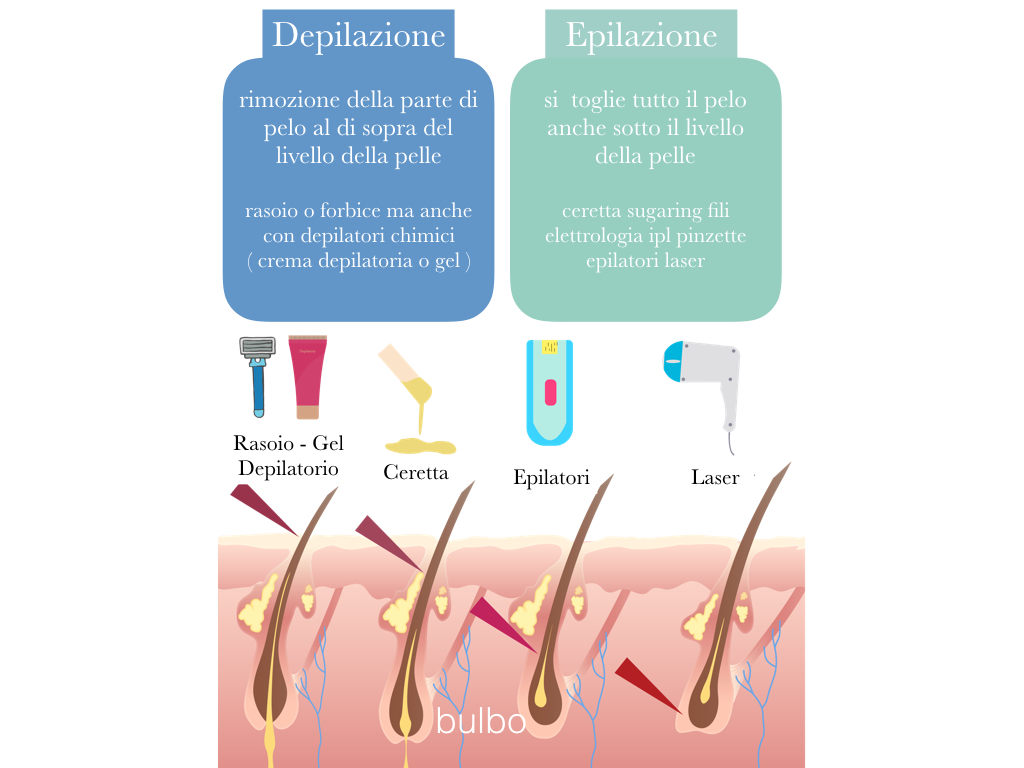
• Hair removal
The removal of the part of hair that is above the skin level. Commonly done with a razor or scissors, but also with chemical depilatory products (depilatory cream or gel).
• Waxing
This involves the complete removal of hair, even the part below the skin's surface. It is achieved through various methods such as waxing, sugaring, threading, electrolysis, IPL, epilators, and lasers. The use of classic tweezers for hair removal also falls under the definition of epilation.
Laser hair removal uses a specific light energy that targets the hair; this light travels along the hair until it reaches its follicle, destroying it along with the hair. Laser hair removal is very precise in acting on hair because it works according to a physical principle called selective photothermolysis: it targets the melanin contained in the hair (the substance that gives hair its colour) and transmits heat only along it, selectively dissolving it.
Laser hair removal works best for people with dark hair and light skin. The contrast between black hair and white skin allows the laser to have maximum hair removal effectiveness. Epilation lasers have no effect on white, grey, or blonde hair. While it might struggle on dark skin tones.
The answer is highly personalised. But if the laser is so efficient and precise in removing unwanted hair, does this mean that just one session, a single appointment, is enough to finally have skin that is free of unsightly hairs, smooth, and hairless?
To put it simply and briefly: NO.
Laser hair removal needs to be repeated several times because hair grows in cycles. Not all hair follicles are active at the same time. The laser treatment is most effective when a hair follicle is in the active growth phase, as this is when it contains the most melanin (which absorbs the laser light).Since some follicles may be dormant or in a resting phase during a single treatment, subsequent sessions are necessary to target these hairs as they enter their active growth phase. Multiple treatments ensure that the majority of hair follicles in the treated area are effectively targeted over time, leading to significant and long-lasting hair reduction.
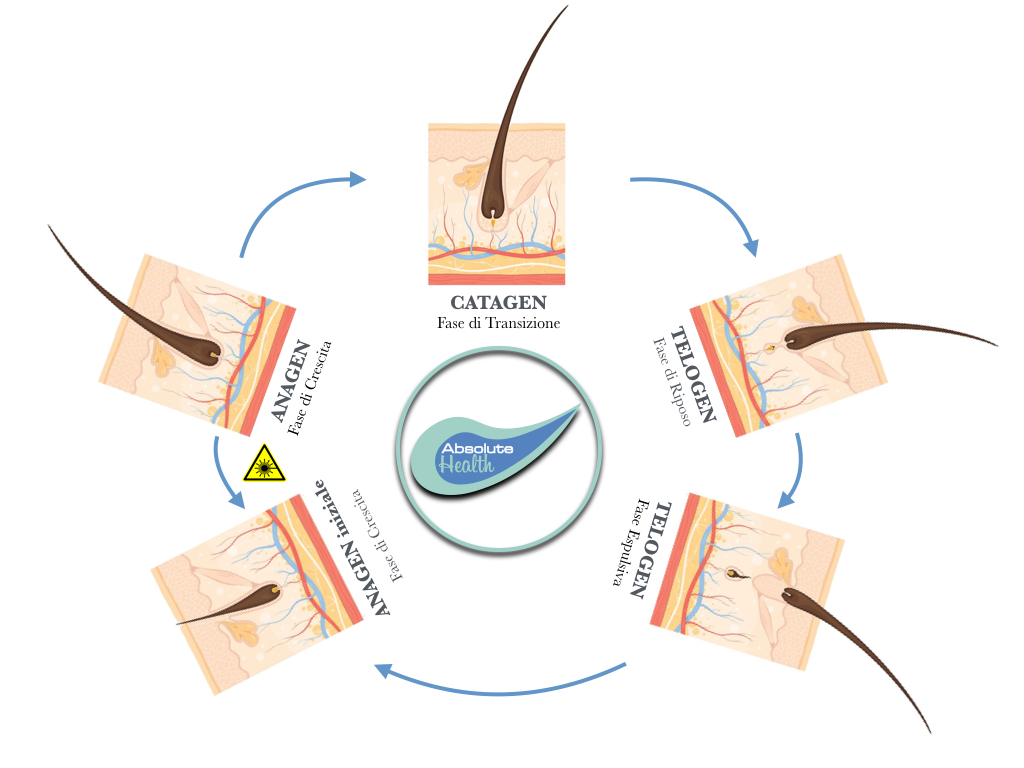
So the laser light can use the surface hair to reach the melanin-filled follicle and eliminate it completely.
Regardless of the time and body area, only 15-20% of hairs are in the Anagen phase of their life cycle. And this is why, according to the American Academy of Dermatology, a reduction of around 10-25% of hair in the treated area can be expected after the first laser hair removal session.
Depending on the colour and thickness of the hair, the area, and skin colour, a different number of sessions will be required. Most people manage to eliminate unwanted hair in a number of sessions ranging between 3 and 8 appointments.
In fast-growing areas such as the upper lip, i.e. the moustache area, laser hair removal sessions may be needed every 4 to 8 weeks; on the back, hair grows more slowly, so sessions may be repeated every 12 to 16 weeks.
Depending on the size of the area to be treated, each laser hair removal appointment can last from a few minutes to an hour or more. So it all depends on how many areas require hair removal and their extent.
Some hairs may come away directly during or immediately after the laser hair removal session. Most will start to fall out about two weeks after the laser hair removal treatment.
Is laser hair removal truly permanent?

Is laser hair removal safe?
Laser technology for excess hair removal has been experimented with since the 1960s and became publicly available in the 1990s.
The first laser hair removal device was approved by the American regulatory body, the FDA, in 1995. Since then, millions of treatments have been performed worldwide; in 2016, laser hair removal was the third most frequent procedure. Aesthetic medicine non-surgical procedure performed in the United States where, in that year alone, more than one million sessions were registered. Laser hair removal is highly regarded by patients and aesthetic doctors. As with all things, there can be risks and problems, which, however, in the vast majority of cases, are temporary.
How to prepare for laser hair removal?
Preparing correctly for a laser hair removal session is a simple, yet important, step to ensure a calm treatment experience and achieve the best results in comfort and safety. A few precautions in the days beforehand are enough to protect the skin and allow the clinician to work in ideal conditions.
- Avoid sun exposure on the areas to be treated in the days leading up to the session, as the skin should not be tanned at the time of treatment.
- Do not apply self-tanners or products that can alter the natural colour of the skin.
- Protect the exposed area with a broad-spectrum sunscreen, especially during the brightest times of the year.
- Avoid skin irritations, scrubs, peels or aggressive treatments in the areas to be lasered.
- Do not use hair removal methods that remove hair from the root, such as waxing, plucking, or depilatory creams, in the weeks leading up to your treatment, as they may reduce the effectiveness of the procedure. Instead, it is recommended to gently shave the area with a razor 24-48 hours before your session, unless otherwise advised by your doctor.
- On the day of your appointment, your skin should be clean, dry, and free from creams, perfumes, deodorants, or other cosmetics.
- It is important to inform the doctor of any current treatments, the skin's tendency to become easily irritated, or previous laser treatments carried out in the past.
Every skin type has unique characteristics. Therefore, in the presence of recent tanning, particular skin sensitivity or specific clinical needs, a doctor can provide personalised guidance, in order to make the treatment even safer, gentler and more effective.
- If herpes, bacterial infections, fungal infections, irritation, or active skin lesions are present in the area to be treated, the treatment must be postponed until full recovery.
- It is important to always inform your doctor of any medications or products you are using, even if taken occasionally or applied topically. Some substances can increase skin photosensitivity and make the skin more reactive to laser light.
- In the event of skin conditions, a tendency to develop hypertrophic scarring or keloids, previous discolouration, or particular skin sensitivity, an accurate assessment is necessary before proceeding.
- Even in the presence of clinical conditions such as epilepsy, diabetes, or skin lesions requiring further assessment, the doctor will carefully evaluate suitability for treatment.
- If the area was recently subjected to Peeling and other intensive exfoliating treatments, it may be advisable to wait a few weeks before undergoing laser hair removal, allowing the skin to recover its balance.
- In people with a marked tendency to develop skin blemishes, such as hyperpigmentation or hypopigmentation, treatment requires particular caution.
- In the presence of vitiligo or already depigmented areas of skin, the suitability should be assessed on a case-by-case basis, as the laser could further alter the uniformity of the complexion.
- In the event of pregnancy, or even a suspected pregnancy, it is always advisable to inform your doctor. As a precautionary measure, treatment may be postponed or adjusted based on the area to be treated and the clinical situation.
Before starting the journey, the consultation with the doctor is fundamental: it allows for the identification of any risk factors, the personalisation of guidelines, and the offering of a truly bespoke treatment, in a context of maximum attention, comfort, and safety.
Can I have laser hair removal if I'm taking medication?
Before starting laser hair removal, it is important to always inform your doctor of any medications, supplements, or topical products you are currently using. Not all of them will be a contraindication, but some can increase skin sensitivity to light and may require more careful evaluation, or a temporary postponement of the session.
Among the products that deserve particular attention are:
- Acne medications and creams, particularly retinoids and exfoliating treatments, which can make the skin more fragile and reactive.
- Some antibiotics, which in certain cases can increase skin photosensitivity.
- Some antidepressants, antihistamines or other medications which, depending on the active ingredient, can promote a more intense skin reaction to light.
- Oncological or immunomodulatory therapies, which always require prior medical evaluation.
- Some cardiovascular drugs or other systemic treatments that can modify the skin's response.
- Herbal products, supplements, or remedies, sometimes perceived as harmless but not always free from effects on photosensitivity.
Topical products also play an important role. Creams based on acids, retinoids or irritant substances can make the skin more delicate, especially in more sensitive areas like the face.
For this reason, the safest choice is not to stop treatment independently, but to always report it during the consultation. It will be the doctor's role to assess the type of medication, the area to be treated, skin sensitivity, and whether it is appropriate to postpone the session or personalise the protocol.
Risks and problems related to laser hair removal
The possibility of having problems following the removal of unwanted hair using laser epilation is related to skin type, the type and colour of the hair, and above all to how well the instructions and care were followed before and after the treatment. After laser hair removal, skin irritation can be expected, which generally disappears in one to three days. Irritation may present itself as discomfort, redness and/or swelling. More rare but more important problems are the formation of blisters, scabs, changes in the smoothness of the skin, scarring, exacerbation of herpes simplex lesions, infections. Rarely, residual hairs in the treated area may lighten and those adjacent to the laser hair removal area may grow more than usual, giving rise to what is called paradoxical hypertrichosis. The skin exposed to laser epilation may rarely become lighter (especially in people who avoid sun exposure before and after treatment, and in darker phototypes), or darken. Usually this change in skin colour is temporary, but sometimes it can
to be permanent. To reduce the frequency of all the negative events listed previously, it is important to follow all the pre and post laser hair removal indications provided in this information guide, and to speak with the doctor who will perform the treatment or under whose direction the laser hair removal will take place, in order to eliminate any preventable causes of problems.
Laser hair removal is generally a well-tolerated treatment. Rather than actual pain, most people report a quick and transient sensation, often described as a mild rubber band snap against the skin.
Naturally, sensitivity can vary from person to person and some areas, such as the face or lip contour, may be more delicate. Areas with a higher density of hair may also be perceived as more sensitive during the session.
The most advanced laser technologies are equipped with cooling systems that help protect the skin and make the treatment more comfortable. In cases of particular sensitivity, the doctor can also consider the use of specific measures to further increase comfort during the session.
What to do after laser hair removal (and what not to do)?
After the treatment, the skin may appear slightly red or more sensitive for a few hours. In most cases, this is a temporary and completely normal reaction. To aid skin recovery and maintain ultimate skin comfort, it is advisable to follow a few simple precautions.
- Avoid direct sun exposure and do not use tanning beds or self-tanning lotions on the treated areas.
- Apply broad-spectrum sunscreen to exposed areas, especially during the brightest times of the year.
- In the first 24-48 hours, avoid rubbing, scrubbing, peeling, vigorous massages, and tight clothing on the treated areas.
- Prefer mild cleansers and keep the skin clean and well-moisturised.
- Avoid sources of intense heat for a few days, such as very hot showers, saunas, and steam rooms, if your skin still appears sensitive.
- In case of redness, follow your doctor's instructions and only use the recommended products.
- Between sessions, avoid hair removal methods that remove hair from the root; if necessary, shaving generally remains the most suitable option, according to the instructions received during your consultation.
- If you experience persistent reactions, marked discomfort, or have any doubts after treatment, it is always important to contact your doctor.
Laser hair removal does not normally require any particular recovery time and, in most cases, allows you to resume your usual activities straight away. For this very reason, when the treatment is carried out with appropriate technologies and with a correct preliminary assessment, it can fit naturally into a personal care routine designed to combine effectiveness, safety, and comfort.
Ask the expert
